
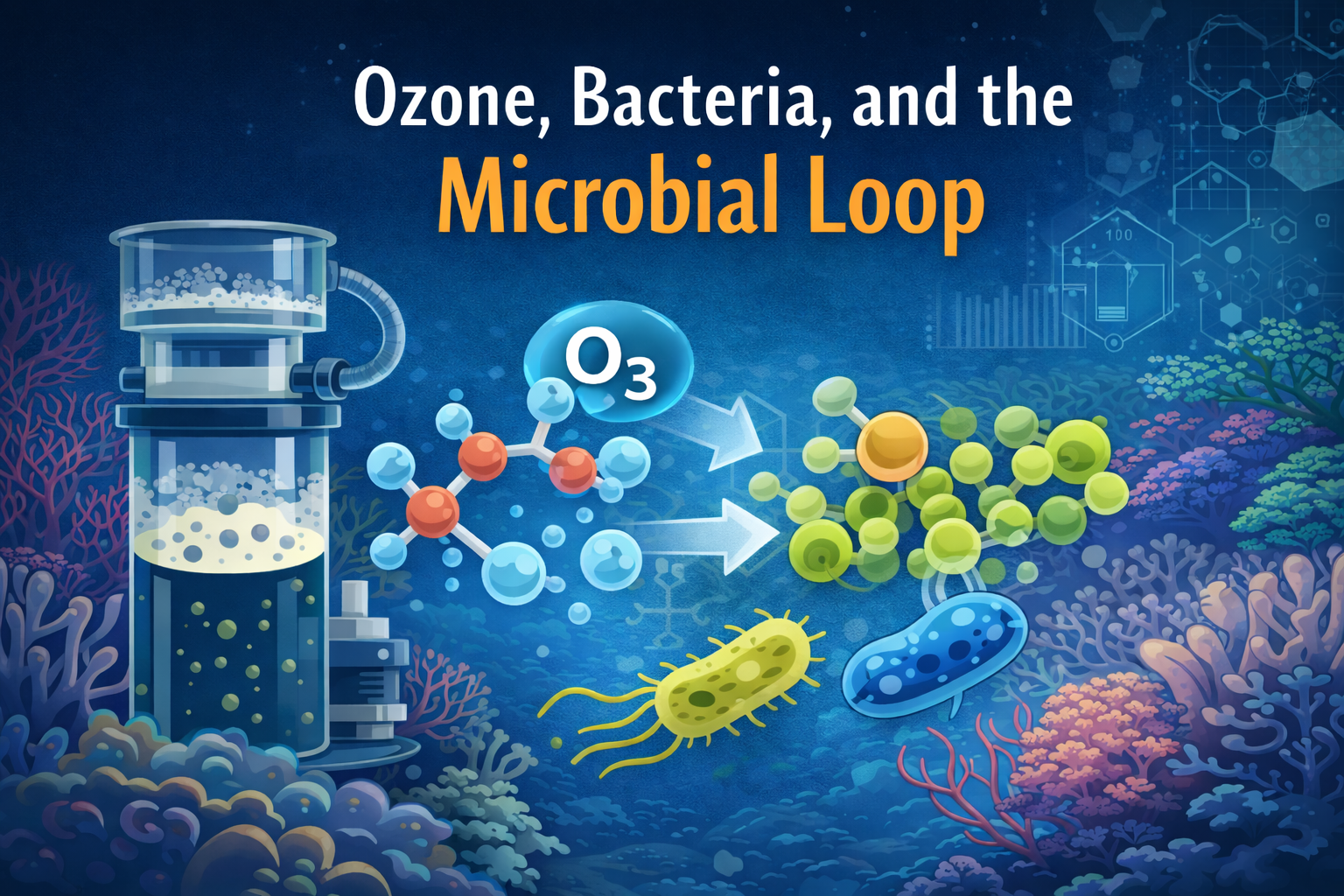
A customer recently reached out to us with the following ask: “I’m interested in learning more about this characteristic of ozone mentioned on the Mutiny Ozone Reactor page: 'Coupled with an efficient protein skimmer, ozone can help improve water quality by breaking down large organic molecules into components more suited to skimming or usable by bacteria. Specifically, how ozone breaks down large organic molecules into components more usable by bacteria. Where can I find more information on this function?” Excellent question, Kyle.
It is a great question because most discussions about ozone stop at one statement: it makes the water clearer. Clarity is the visible outcome. The mechanism is carbon chemistry operating inside a closed system. To understand that mechanism further, we need to follow the carbon.
In the ocean, dissolved organic carbon is constantly diluted, mixed, grazed, and transported away. In a reef aquarium, dilution is engineered rather than automatic. Each feeding event increases carbon density within a fixed volume of water. There is no tidal reset. Carbon accumulates unless it is processed biologically and exported mechanically. Marine scientists refer to the total dissolved organic carbon present at any given moment as the DOC pool. The term' pool' simply means a reservoir. It includes coral mucus, fish waste, partially degraded proteins, lipids, carbohydrates, aromatic compounds, and humic-like substances. In a closed system, like our reef tanks, carbon input is intentional. Carbon export must also be intentional. The relevant question is not how much carbon exists, but how efficiently it turns over.
Dissolved organic carbon is chemically diverse. Some compounds are readily metabolized by bacteria. Others are structurally complex and resist breakdown due to aromatic rings, conjugated bonds, and stable carbon frameworks. Over time, especially in mature aquariums, the slower fractions accumulate. You may observe yellowing water, reduced light penetration, skimmer performance that does not reflect feeding intensity, or a gradual decline in redox potential despite adequate aeration. This situation is often described as “high DOC,” but a more accurate term is “slow DOC.” The issue is turnover, not simply concentration. In a closed system, slow-turnover compounds accumulate because there is no large-scale dilution to remove them.
At reef-appropriate dosing levels, ozone does not sterilize the aquarium or convert most carbon into carbon dioxide. It modifies molecular structure. Ozone reacts preferentially with carbon–carbon double bonds, aromatic structures, and other reduced functional groups. Larger organic molecules fragment into smaller intermediates such as aldehydes, ketones, and carboxylic acids. Two structural changes follow. The average molecular size decreases, and the oxygen content increases. The carbon remains present, but it is no longer structurally resistant. Ozone does not directly reduce the size of the DOC reservoir. It alters the distribution of compounds within it, shifting portions toward greater lability. In a closed system, this redistribution affects the rate at which carbon moves through biological pathways.
Ozone also changes oxidation state. When reduced organic compounds accumulate, they increase chemical oxygen demand and suppress redox potential. Partial oxidation of those compounds shifts the balance toward a more oxidized state. ORP increases as a result, but ORP is only an indicator. The underlying change is the ratio between reduced carbon species and oxidized intermediates. That ratio influences microbial respiration, nitrogen transformations, sulfur cycling, and oxygen availability at the coral surface. Ozone changes redox chemistry, not just the ORP reading.
By now, you must be asking, what do the bacteria consume? Once complex dissolved organic matter is fragmented, heterotrophic bacteria gain access to smaller substrates that can enter central metabolic pathways more readily. Low-molecular-weight organic acids and oxidized intermediates move through glycolysis and the tricarboxylic acid cycle. Some carbon is oxidized to carbon dioxide to generate energy. Some become new cellular biomass. Some contribute to extracellular material that promotes aggregation and biofilm stability. The microbial loop is the conversion of dissolved carbon into living microbial mass. In the ocean, that biomass may be transported away or incorporated into food webs. In a reef aquarium, it becomes particulate organic matter that can be removed by skimming. Dissolved carbon is difficult to export mechanically. Microbial biomass is not.
Bacterial growth requires more than carbon. Nitrogen and phosphorus are also necessary for biomass production. When ozone increases, carbon lability and bacterial growth accelerate, and bacteria assimilate ammonium, nitrate, and phosphate into new cellular material. This shifts nutrients from dissolved to biomass-bound forms. In heavily fed aquariums, carbon availability often limits microbial turnover. Increasing carbon accessibility changes how nutrients are partitioned and ultimately exported. In a closed loop, carbon chemistry influences nutrient dynamics.
Around the coral tissue, a thin diffusive boundary layer forms, where water exchange slows. Within that microenvironment, microbial respiration directly affects oxygen concentration at the coral surface. If dissolved carbon accumulates and fuels excessive microbial growth, localized oxygen depletion can occur at night even when bulk oxygen levels appear stable. Carbon availability shapes microbial behavior, and in a closed system, those effects are amplified. Carbon balance, therefore, has ecological implications beyond water clarity.
Protein skimmers remove particulate organic matter and microbial biomass via adsorption at the air–water interface. Ozone enhances export in two ways. Some oxidized organic fragments become more surface-active and adhere to air bubbles more readily. At the same time, bacterial multiplication converts dissolved carbon into particulate biomass.
The sequence is straightforward: Dissolved carbon is conditioned by ozone. Bacteria consume the conditioned carbon. Biomass increases. Skimmers (foam fractionation for our Ozzie friends) remove that biomass. In a closed system, this dissolved-to-particulate conversion accelerates turnover and reduces the accumulation of slow fractions. This is why skimmate often darkens and becomes more consistent when ozone is applied properly.
This often leads to the discussion of concentration versus imbalance. Natural reefs operate at lower dissolved organic carbon concentrations and far greater dilution. Closed aquariums operate at higher carbon loading per liter because feeding is concentrated and there is no dilution. The problem is not elevated DOC alone. It is an imbalance. When carbon input exceeds processing and export capacity, the DOC reservoir shifts toward slower fractions. Microbial respiration patterns adjust. Oxygen demand changes. Turnover slows. The objective is not zero DOC. The objective is sustained flow.
Where Ozone Fits. Ozone is not a strip-the-water solution. When applied intentionally, it functions as a carbon conditioning step within a broader export strategy. It reduces the accumulation of chromophoric compounds, increases the lability of complex DOC, supports microbial turnover, enhances conversion to exportable biomass, and improves foam fractionation efficiency. In a closed marine system, carbon flow does not self-correct. It must be designed. Ozone is one tool for maintaining that design when used responsibly and with appropriate control.
In Summary
Ozone does more than improve clarity. It modifies dissolved carbon chemistry, shifts redox balance, influences microbial metabolism, and supports export in a system without natural dilution. In a closed reef tank, carbon flow must be engineered.
In a reef tank:
- Dissolved organic carbon forms a constrained reservoir
- Without efficient turnover, slower fractions accumulate
- Ozone fragments complex organics into more labile intermediates
- Bacteria convert those intermediates into biomass
- Protein skimmers export that biomass, completing the carbon cycle
We hope you found this topic interesting. If you have a question, feel free to share it, and you may see it turned into a blog post.
PRODUCT PLUG.
If you'd like to order an Avast Marine Mutiny 2.1, click HERE.
GLOSSARY
Dissolved Organic Carbon (DOC)
Organic carbon compounds are dissolved in aquarium water. These originate from coral mucus, fish waste, uneaten food, and metabolic byproducts. DOC is chemically diverse and constantly changing.
DOC Pool
The total reservoir of dissolved organic carbon present in the system at a given time. The term “pool” refers to the collection of compounds, not a single uniform substance.
Labile DOC
Carbon compounds that bacteria can readily metabolize. These typically include low-molecular-weight organic acids and simple intermediates.
Refractory DOC
Structurally complex organic compounds that resist rapid microbial degradation. Often includes aromatic or highly conjugated molecules that can accumulate in closed systems.
Chromophoric Dissolved Organic Matter (CDOM)
The fraction of dissolved organics that absorbs light, especially in the blue spectrum. Responsible for yellowing water and reduced light penetration.
Microbial Loop
The biological pathway by which dissolved organic carbon is consumed by heterotrophic bacteria and converted into microbial biomass.
Heterotrophic Bacteria
Microorganisms that obtain energy and carbon by consuming organic compounds rather than fixing inorganic carbon.
Lability
A measure of how easily a compound can be metabolized by microbes. Increased lability generally corresponds to faster microbial turnover.
Redox (Oxidation–Reduction State)
The balance between oxidized and reduced chemical species in the water. Influences microbial metabolism, nutrient cycling, and oxygen demand.
ORP (Oxidation-Reduction Potential)
A measurement that reflects the oxidative state of the water. ORP is an indicator of redox balance but does not directly measure ozone concentration.
Chemical Oxygen Demand (COD)
A measure of the amount of oxygen required to oxidize reduced compounds in water. Elevated reduced organic load increases COD.
Diffusive Boundary Layer
A thin layer of water surrounds coral tissue where flow slows, and chemical exchange is limited. Microbial respiration within this layer can influence localized oxygen availability.
References and Further Reading
The concepts described in this article are grounded in marine biogeochemistry and aquaculture research examining dissolved organic matter transformation, ozonation, microbial processing, and foam fractionation.
Gregersen, K. J., et al. (2021). Foam fractionation and ozonation in freshwater recirculation aquaculture systems. Aquacultural Engineering, 93, 102158.
Kovács, B. D., et al. (2023). Evaluating protein skimmer performance in a marine recirculating aquaculture system with ozonation. Aquacultural Engineering, 103, 102381.
Aguilar-Alarcón, P., et al. (2022). Impact of ozone treatment on dissolved organic matter in recirculating aquaculture systems. Water Research, 215, 118263.
Hansell, D. A., & Carlson, C. A. (2015). Biogeochemistry of Marine Dissolved Organic Matter. Academic Press.
Haas, A. F., et al. (2016). Global microbialization of coral reefs. Nature Microbiology.


